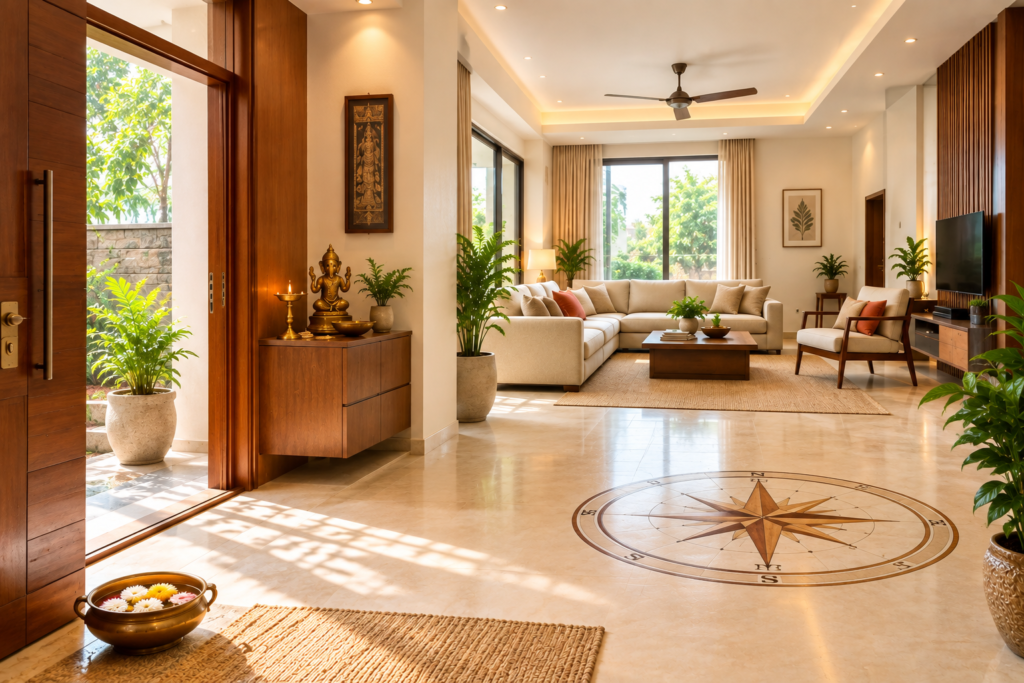
Vastu correction does not always mean breaking walls, changing entrances or undertaking expensive renovations. In many homes, small, practical changes in furniture placement, space utilisation and directional usage can make a noticeable difference to how the space functions and feels.
Here are two examples that demonstrate this approach: a Delhi flat with a cluttered Brahmasthan and a Pune house with a south-facing entrance.
Case Study 1: Delhi Flat – Clearing a Cluttered Brahmasthan
The Challenge
The central area of the Delhi flat had become heavily occupied with furniture and everyday items. This created a visually crowded space and restricted movement through the home.
From a Vastu perspective, the Brahmasthan—the central zone of the home—is traditionally kept open, light and free from heavy obstruction.
The Vastu Correction
Instead of undertaking structural changes, the focus was on decluttering the Brahmasthan and replacing bulky furniture with lighter, more functional pieces.
The changes included:
- Removing unnecessary items from the central area
- Reducing heavy furniture around the Brahmasthan
- Improving movement and openness
- Using lighter furniture to create visual balance
- Keeping the central zone cleaner and more spacious
The Outcome
Once the centre of the flat was cleared, the space felt more open and easier to navigate. The residents also reported a more positive experience of the home.
The key lesson is simple: sometimes Vastu correction begins with removing what is unnecessary rather than adding something new.
Case Study 2: Pune House – Working with a South-Facing Entrance
The Challenge
The Pune property had a south-facing main entrance, which raised concerns for the occupants regarding the overall Vastu balance of the house.
However, the solution was not to immediately consider changing the entrance. Instead, attention was given to how different parts of the house were being used.
The Vastu Correction
The focus was on increasing the use of the Northeast (NE) zone for appropriate daily activities while creating better functional balance across the home.
The approach included:
- Shifting suitable daily activities towards the Northeast
- Keeping the NE area lighter and more open
- Reducing unnecessary clutter
- Improving the overall flow and usability of the house
- Making corrections without major structural alterations
The Outcome With the revised space utilisation, the residents experienced the home differently and reported reduced stress and a more comfortable day-to-day environment.
This case demonstrates an important principle: a south-facing entrance does not automatically mean a home is unsuitable. The complete layout, directional zones and usage of the space need to be considered together.
What These Two Vastu Cases Teach Us
Both homes had different challenges, but the solution followed the same philosophy:
Understand the space → identify the imbalance → make practical corrections → observe the change.
Instead of relying only on expensive renovations, homeowners can often begin with:
- Decluttering
- Furniture repositioning
- Improving natural movement
- Keeping key zones light and functional
- Changing how particular areas are used
- Improving cleanliness, light and openness
Traditional Vastu guidance also emphasizes keeping the Brahmasthan unobstructed and the Northeast relatively light and clutter-free.
Frequently Asked Questions
Q. What is Brahmasthan in Vastu?
A. The Brahmasthan is the central zone of a home according to the Vastu Purusha Mandala. It is traditionally kept open, clean and free from heavy furniture or unnecessary storage.
Q. Is a south-facing entrance bad according to Vastu?
A. Not necessarily. A south-facing entrance should be assessed along with its exact placement, the overall floor plan and how different zones of the property are being used. Vastu correction does not always require changing the entrance.
Q. Can Vastu defects be corrected without renovation?
A. Yes. Depending on the property and the specific Vastu concern, practical corrections may include decluttering, furniture placement, directional usage, lighting and space management rather than structural renovation.
Q. Why is the Northeast important in Vastu?
A. The Northeast is traditionally considered a significant and lighter zone in Vastu. It is generally recommended to keep this area clean, open and free from heavy storage.
Q. Does Vastu correction guarantee positive results?
A. Vastu is a traditional system of spatial planning and belief, and individual experiences can vary. A professional assessment should consider the complete property rather than applying isolated Vastu rules.
Q. Every property is different. A correction that works for one home may not be appropriate for another.
A. Whether you are dealing with a cluttered Brahmasthan, a south-facing entrance, poor space utilisation or other Vastu concerns, the right approach is to assess the complete layout before recommending changes.
Q. Looking for practical Vastu guidance for your home?
A. Consult Yogesh Dave for a personalised assessment focused on meaningful corrections rather than unnecessary structural changes.